May 20, 2025
The Environmental Protection Agency (EPA) has a long history of regulating the disposal of pharmaceuticals, specifically through its enforcement of the Resource Conservation and Recovery Act (RCRA), the public law that creates the framework for the proper management of hazardous and non-hazardous solid waste.
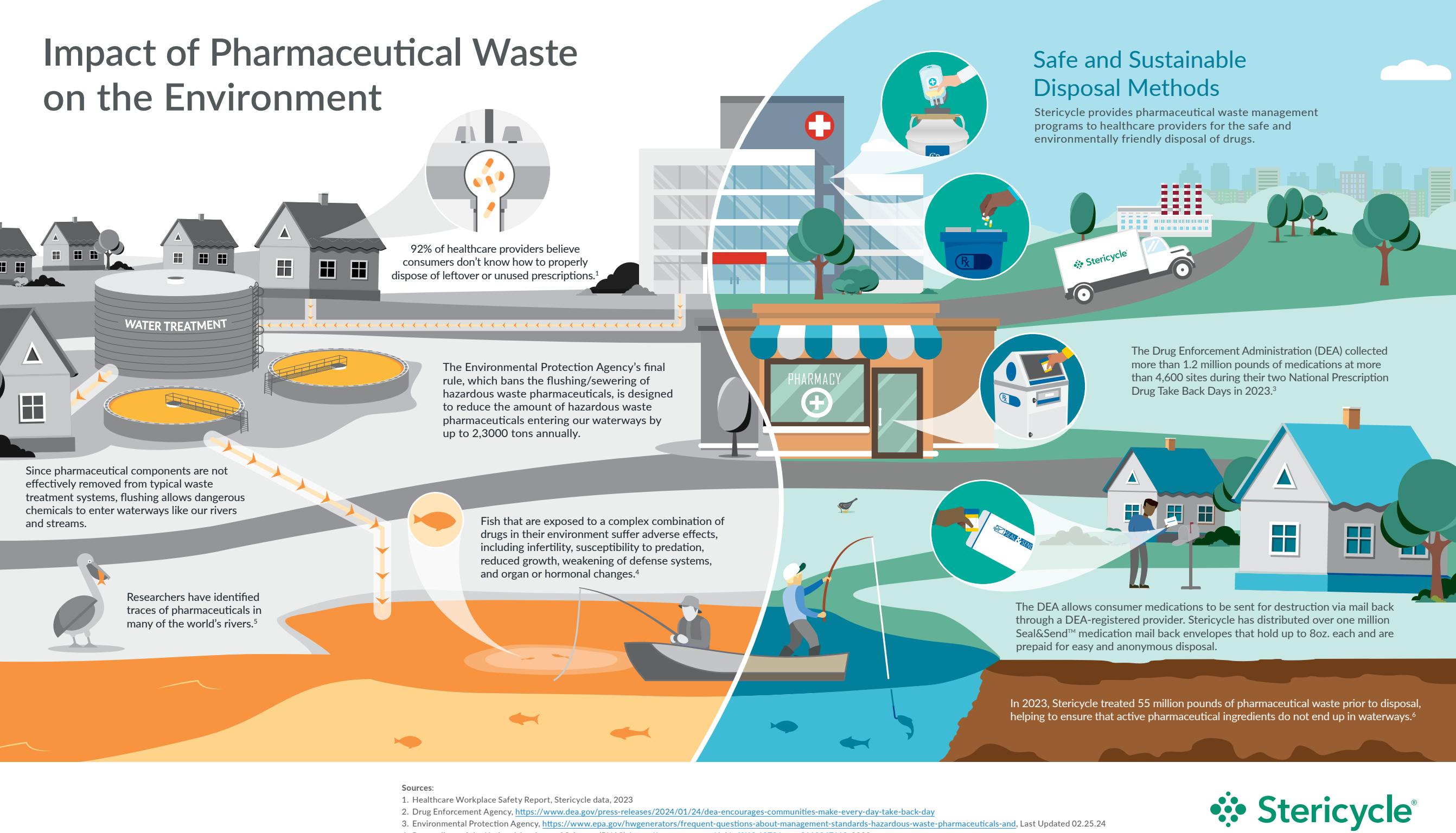
Our EPA knowledge center is intended to keep the healthcare community informed on EPA regulations regarding pharmaceutical and other hazardous wastes generated in healthcare facilities. While not exhaustive, we hope it serves as a useful resource center and overview of related regulations and guidance by governing bodies. It’s critical for healthcare organizations to also stay abreast of local and state regulations on the generation and management of all wastes generated within their facilities.
For over 30 years, WM has steadfastly strived to help keep our customers safe, compliant, while promoting sustainability. Our mission is rooted in protecting human health and well-being for the businesses and communities we serve. With that, we have a deep connection and respect for the EPA’s mission.
Americans have clean air, land and water;
National efforts to reduce environmental risks are based on the best available scientific information;
Federal laws protecting human health and the environment are administered and enforced fairly, effectively and as Congress intended;
Environmental stewardship is integral to U.S. policies concerning natural resources, human health, economic growth, energy, transportation, agriculture, industry, and international trade, and these factors are similarly considered in establishing environmental policy;
All parts of society--communities, individuals, businesses, and state, local and tribal governments--have access to accurate information sufficient to effectively participate in managing human health and environmental risks;
Contaminated lands and toxic sites are cleaned up by potentially responsible parties and revitalized; and
Chemicals in the marketplace are reviewed for safety.
WM was a pioneer of pharmaceutical disposal and to this day, we’re committed to the innovation of new products and services to help our client-partners reach their sustainability goals while properly disposing waste.
Together, we can prevent pharmaceutical waste from contaminating the environment and entering our waterways.
May 20, 2025
The EPA Final Rule on Hazardous Waste Pharmaceuticals (Subpart P) and Amendment to the P075 Listing for Nicotine
The Final Rule of the Environmental Protection Agency (EPA), under 40 CFR 266 subpart P on the management of hazardous waste pharmaceuticals became effective on August 21, 2019.
The rule was effective immediately in AK, FL, IA, KY, NJ, PA, VA and Puerto Rico.
States that do not require legislation have until July 1, 2021 to adopt the rule, states that do require a legislative change in order to adopt the rule are given until July 1, 2022 to adopt.
As a result, the effective dates have varied by state. It's very important to understand that until your state adopts the rule, the current hazardous waste regulations are applicable.
The exception to state adoption is the ban on flushing. This requirement was proposed under the Hazardous and Solid Waste Amendments. Requirements implemented under this authority became effective in all states on August 21, 2019.
For more information, visit the EPA website.
To view the Final Rule and for additional information visit the EPA website.
May 20, 2025
The term hazardous drug (HD), refers to drugs found on the NIOSH list of Hazardous drugs. These drugs are listed due to being carcinogenic and/or for causing other toxic effects on humans. The list is further divided into 3 groups. Group 1 includes all antineoplastic, Group 2 includes non-antineoplastic drugs that are a reproductive hazard and meet other criteria from NIOSH to be considered an HD, and Group 3 includes non-antineoplastic drugs that are only reproductive hazards.
A drug that possesses any one of the following six characteristics is considered a hazardous drug, even if it does not appear on the NIOSH list:
• Genotoxicity
• Carcinogenicity
• Teratogenicity
• Fertility impairment or reproductive toxicity
• Serious organ toxicity at low doses
• Drugs with a chemical structure and profile that resemble other drugs known to be hazardous
The Environmental Protection Agency (EPA) regulates hazardous waste pharmaceutical disposal through the Resource Conservation and Recovery Act (RCRA). The law requires companies that use hazardous chemicals, including hazardous waste pharmaceuticals, to classify and dispose of them following prescribed criteria and procedures.
About 5% to 10% of pharmaceutical products can be classified as RCRA hazardous waste. EPA regulations do not require organizations to treat non-RCRA pharmaceutical waste as hazardous waste, though some States may have requirements. It is considered best practice to properly dispose of all pharmaceutical waste, whether RCRA or non-RCRA. Other agencies that regulate medicine waste disposal include the U.S. Department of Transportation (DOT), which covers how drug waste should be transported to waste management facilities, and the U.S. Drug Enforcement Administration (DEA), which oversees controlled substance waste management.
Drugs used in chemotherapy, including antineoplastics and cytotoxics, are potent and toxic agents that can cause serious health problems for employees if the drugs and drug waste are improperly handled and disposed of. To protect staff, healthcare organizations should have clear waste disposal processes that mitigate exposure risk.
The U.S. Pharmacopeia Convention (USP) is a scientific nonprofit organization with a mission “to improve global health through public standards and related programs that help ensure the quality, safety, and benefit of medicines and foods.” On December 1, 2019, General Chapter 800 of the USP published guidelines on handling hazardous drugs in healthcare settings. The standards set under the USP 800 should not be confused with and is unrelated to the regulations under the EPA Final Rule on Hazardous Waste Pharmaceuticals.
The USP 800 is a chapter of the USP that identifies best practices, setting industry standards for handling hazardous drugs (HDs) “to protect patients, healthcare personnel, and the environment.”
May 20, 2025
On May 30, 2017, the Hazardous Waste Generator Improvements Rule (HWGIR) was effective. EPA made over 60 revisions to the hazardous waste generator rules with this rulemaking. The goal of the changes was to improve compliance of generators by creating an improved user-friendly regulation; for example, the EPA has re-organized and consolidated definitions and regulations into one area for all generators. This guide is intended to provide a high-level overview of these changes.
States were required to adopt changes that are more stringent than the current regulations but did not have to incorporate changes that are less strict than current regulations. States adoption is not yet complete, please visit EPA’s site for the most current state adoption information.
Under EPA’s Hazardous Waste Generator Improvements Rule, small quantity generators (SQGs, generating between 200 and 2200 lbs of non-acute hazardous waste per month) are now required to re-notify every four years. To satisfy this requirement, SQGs need to update their Notification of RCRA Subtitle C Activities (Site Identification Form), also known as EPA Form 8700-12, or state equivalent by September 1, 2025. This is required in states that have adopted the Hazardous Waste Generator Improvements Rule, a list of those states can be found here. The EPA's site on this topic can be found here.
Note: SQGs submitting Site ID forms in the four years prior to 2021 for another purpose, such as notifying as a healthcare facility under the 2019 Hazardous Waste Pharmaceuticals final rule, satisfy the re-notification requirement.
You may also be sent an email or postcard reminding of this requirement by the EPA and/or your state regulatory agency. Some states have electronic reporting options available for this notification.
SQGs are encouraged to submit the re-notification electronically via MyRCRAID by logging into RCRAInfo and requesting MyRCRAID permissions for your site (if you have not already registered). You can log into or register for RCRAInfo here. Then, you should create a New Submission and select the option to provide a subsequent notification. The form will be pre-populated with the most recent information for your site in RCRAInfo.
SQGs should submit the Site ID Form and select the choice in Item 1 to obtain or update an EPA ID number. Complete the form with the current information for your site. Sign the form and submit it.
For more information and to see if this requirement is in effect in your state, contact your state or EPA regional office. Additional information regarding this requirement as well as the federal paper form can be found here.
Additional information regarding hazardous waste generation and applicable regulations can be found at www.epa.gov/hwgenerators.
May 20, 2025
Pharmaceutical Waste Management: Steps to Compliance: Join Cara Simaga, Director of Regulatory Affairs, as she presents pharmaceutical waste management: steps to compliance. In this webinar, Cara provides insights on how to properly dispose of pharmaceutical waste, including an update on the state adoption of Subpart P and the Nicotine Exclusion.
Looking Ahead at Regulatory Changes in 2020: A look ahead at regulatory changes in 2020. In this webinar, you will learn about, specifically about state adoption of key federal waste rules, the generator improvement rule and pharmaceutical waste rule, state changes or updates to regulated medical waste rules and other key waste management and related regulations.
How to Prepare for the EPA Final Rule on the Management of Hazardous Waste Pharmaceuticals: An overview of the EPA rule on hazardous waste pharmaceuticals and how your organization can remain compliant. In this webinar, we discuss current hazardous rules that apply to pharmaceuticals today and why you need to know them even with the new rule, highlights of the rule and how it can make management of pharmaceutical waste easier, as well as two important steps you can take today to prepare for when the rule is effective in your state.
Understanding Pharmaceutical Waste Disposal and Compliance: An overview of pharmaceutical waste disposal and how your organization can maintain compliance. In this webinar, we review the Resource Conservation and Recovery Act (RCRA), the EPA Final Rule Subpart P, and safe disposal of controlled substances . Viewers will also learn about how COVID-19 has impacted pharmaceutical waste streams.
May 20, 2025
EPA Final Rule: Management Standards for Hazardous Waste Pharmaceuticals and Amendment to the P075 Listing for Nicotine
EPA Final Rule: Hazardous Waste Generator Improvements
Applicability of 40 CFR Part 266 Subpart P to Intermediate Care Facilities (PDF)
Containers that Once Held P-listed Pharmaceutical Waste (PDF)
EPA's regulations on reverse distribution and policy on reverse logistics
Manifesting Non-Creditable Hazardous Waste Pharmaceuticals - New Four Character Code (PDF)
Medicinal nitroglycerine that does not exhibit the reactivity characteristic (D003) is not P081 (PDF) (2 pp, 19 K)
Nicotine as the sole active ingredient of E-liquids (PDF) (4 pp, 698 K)
Nicotine-containing products that are legitimately recycled are not solid waste (PDF)(3 pp, 586 K)
Scope of Hazardous Waste Listing P042 (Epinephrine) (PDF) (8 pp, 1.2 MB)
Waste 360: Navigating EPA’s Hazardous Waste Pharmaceuticals Rulemaking (Part One)
Waste 360: Navigating EPA’s Hazardous Waste Pharmaceuticals Rulemaking (Part Two)
Healthcare Purchasing News: Preparing for EPA’s final rule on hazardous waste pharmaceutical management
McNight’s Long-Term Care News: How new hazardous waste pharmaceuticals rule will impact LTC
Environment + Energy Leader: What to Know about New Management Standards for Hazardous Waste Pharmaceuticals