Hazardous Waste Manifest Guide
The hazardous waste manifest system is designed to track hazardous waste from generation to disposal.
Hazardous waste manifests are required per regulations established by the U.S. Environmental Protection Agency (EPA) and the U.S. Department of Transportation (DOT). A manifest is required for anyone who transports, or offers for transport, a hazardous waste.
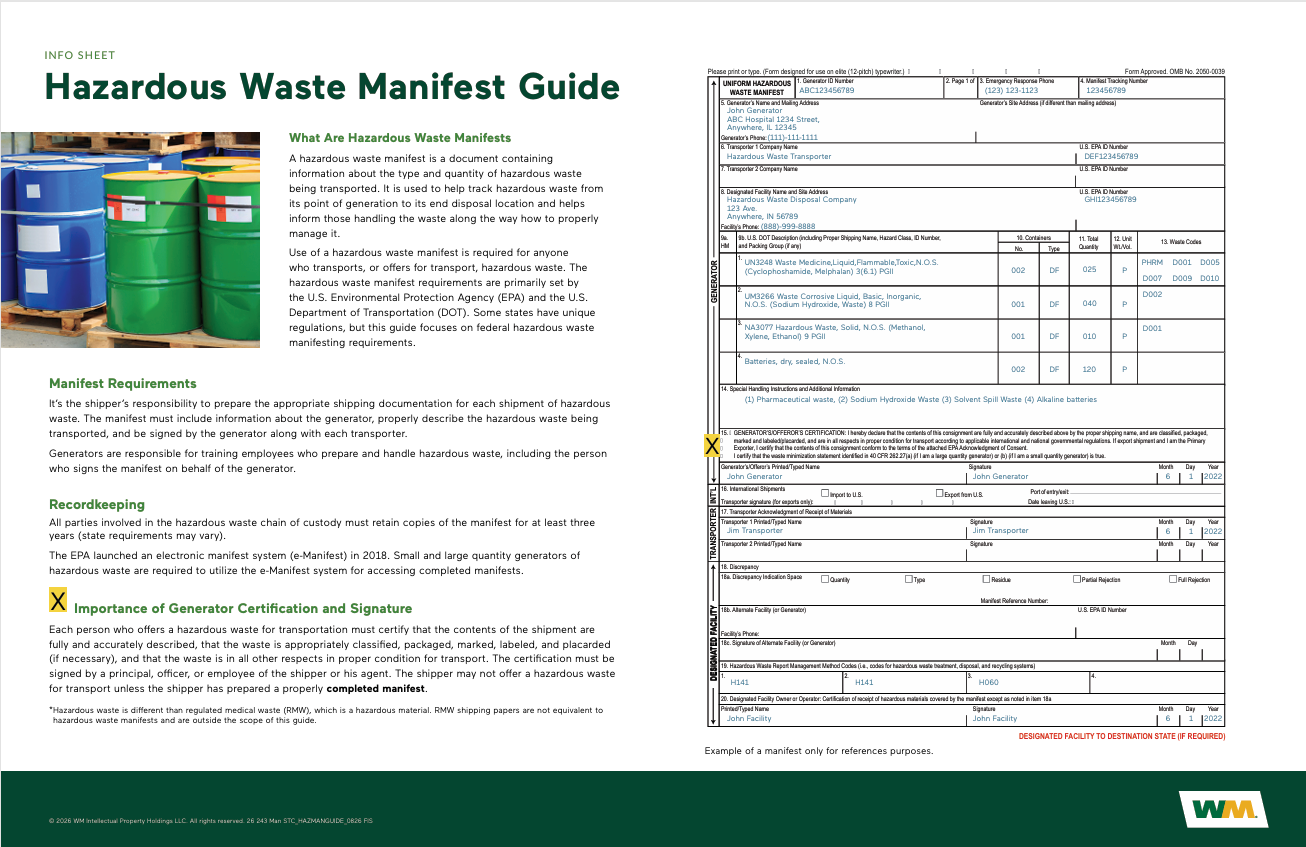
Manifests contain information about the type and quantity of the waste and include signature lines for all parties involved in the generation, transportation, and disposal process. Each party that handles the waste signs and retains one copy of the form. When the hazardous waste reaches its final destination, that facility then returns the completed manifest to the original generator of the hazardous waste to retain for their records. This can be done electronically through the e-Manifest system in lieu of sending a paper copy.
What Are the Requirements of Hazardous Waste Manifests?
Although the requirements may vary by state, some of the typical items included on hazardous waste manifests include:
Generators
Generator ID Number
Emergency Response Phone
Manifest Tracking Number
Generator’s Name
Generator’s Address
Generator’s Phone
A Description of the Waste, including Container Quantity and Type, Weight/Volume, and Waste Codes
Any Special Handling Instructions
Generator’s Certification (Signature and Date)
Transporters
Transporter’s Name
Transporter’s Signature and Date
Designated Facility
Designated Facility Name
Designated Facility Address
Designated Facility ID Number
Designated Facility Phone
Hazardous Waste Treatment/Disposal Codes
Designated Facility Certification (Signature and Date)
How Long Should You Keep Hazardous Waste Manifests?
Generators should keep a copy of each signed manifest for at least three years from the date it was accepted by the initial transporter (state requirements may vary). As of January 22, 2025, large quantity generators (LQGs) and small quantity generators (SQGs) of hazardous waste are also required to maintain credentials to access final manifest copies through the EPA's e-manifest system (see additional details below).
How Should You Fill Out a Hazardous Waste Manifest?
The EPA has an instruction guide for completing the uniform hazardous waste manifest.
What Training Is Required to Sign a Hazardous Waste Manifest?
The training requirements for hazardous materials employees are defined in the DOT Hazardous Materials Regulations at 49 CFR Part 172, Subpart H. These regulations specify training requirements for general awareness and familiarization, function-specific training, and safety training. The training must occur within 90 days of employment for new employees and be repeated every three years.
There is additional training as specified by the Subtitle C of the Resource, Conservation and Recovery Act (RCRA). Depending on one’s generator status (determined by the amount of hazardous waste generated each month), training could include complying with the emergency preparedness and personnel training requirements.
Who Can Sign a Hazardous Waste Manifest?
The person signing the manifest should have first-hand knowledge of the information included on it and the regulations that apply to the waste being transported under it. The generator must certify that the materials are properly classified, described, packaged, marked, and labeled, and in proper condition for transporting. In some situations, the signatory could be held personally liable if there are significant discrepancies on the manifest.
What Are E-Manifests?
In 2018 the EPA launched the e-Manifest system, a national system for electronically transmitting tracking forms for hazardous waste shipments. The EPA strongly encourages all generators, transporters, and disposal facilities to fully adopt the electronic manifesting system. Depending on a facility's generator status, they may be required to utilize the e-Manifest system at a minimum to access final manifest copies. The EPA offers more information about e-Manifest registration.
Learn more about WM’s solutions for hazardous pharmaceutical and hazardous waste disposal.
This article is for general information purposes only and should not be construed as legal advice on any specific facts or circumstances.
Hazardous Waste Manifest Guide
Download Now
Related Content

Controlled Substance Disposal: Inventory vs. Wastage
August 10, 2026

Managing Category A Waste in Healthcare: Key Preparedness Considerations
July 08, 2026
Understanding OSHA’s HazCom Standard & Training Requirements
May 19, 2026

What Patients and Caregivers Should Know About Disposing of Cancer Drugs...
March 03, 2026
