Understanding OSHA’s HazCom Standard & Training Requirements
The Occupational Safety and Health Administration (OSHA) plays a critical role in protecting workers from a wide range of workplace hazards. Among its many regulations, two standards that are particularly relevant for healthcare organizations include the Bloodborne Pathogens Standard and the Hazard Communication Standard (HCS). Given the complexity of these occupational health and safety rules, it may not be surprising that the HCS was the second most frequently cited workplace safety standard in 2025.
What is the Hazard Communication Standard?
OSHA’s hazard communication standard requires employers to inform employees about hazardous chemicals they may use or be exposed to at work. The Hazard Communication Standard, often called “HazCom,” outlines what information must be shared, when, and with whom. It includes five primary components:
Maintaining a master list of hazardous chemicals used in the facility
In 2012, OSHA began aligning the HCS with the Globally Harmonized System (GHS), a set of international criteria for classifying hazards. The GHS specifies what information organizations must use on labels, SDSs, and other hazard communications.
Recent HazCom Standard Updates: 2024 Final Rule
In July 2024, OSHA published a final rule aligning the HCS primarily with the seventh revision of the United Nations’ GHS. The updates aim to make labels and SDSs clearer and more consistent.
The HCS final rule compliance timelines are as follows:
Chemical manufacturers, importers, and distributors must update labels and SDSs:
Substances: by May 19, 2026
Mixtures: by Nov. 19, 2027
Employers must update workplace labels, hazard communication programs, and training (if needed):
Substances: by Nov. 20, 2026
Mixtures: by May 19, 2028
Employers must maintain a copy of the SDS for each hazardous chemical in the workplace. However, some exceptions apply:
Consumer products: If employees use a consumer product in the same manner and frequency as a consumer, HCS requirements such as maintaining an SDS do not apply.
Cosmetics: Items intended for personal use by employees are also exempt.
What Does the Hazard Classification and Labeling Process Involve?
OSHA defines hazard class as the nature of a health or physical hazard. Health hazards reflect how the chemical affects a person’s health and may include things like acute toxicity (any route of exposure), carcinogenicity, skin corrosion or irritation, serious eye damage or irritation, and aspiration hazards.
Physical hazards are chemicals that are classified as posing certain hazardous effects, including chemicals that are flammable (gases, liquids, or solids), corrosive to metal, aerosols or otherwise under pressure, self-heating, and others.
Health and physical hazards are also given a category designation indicating how dangerous the item is on a scale of one to four, with one being the most hazardous and four being the least.
To comply with OSHA’s HazCom standard, healthcare organizations must maintain a list of the hazardous chemicals they have on site. To do this, an organization could conduct an inventory by walking through the facility to identify all hazardous chemicals onsite. In addition, compliance officers could reach out to department heads and request a list of hazardous chemicals found in their individual departments.
Do We Need a Written Hazard Communication Program?
Yes, under HazCom regulations, a written program is required. WM provides an OSHA HazCom Program Template through the OSHA Safety Plan Builder tool to support program development. The template covers key plan requirements and allows facilities to add site-specific details.
What are the Labeling Requirements for Hazardous Chemicals Containers?
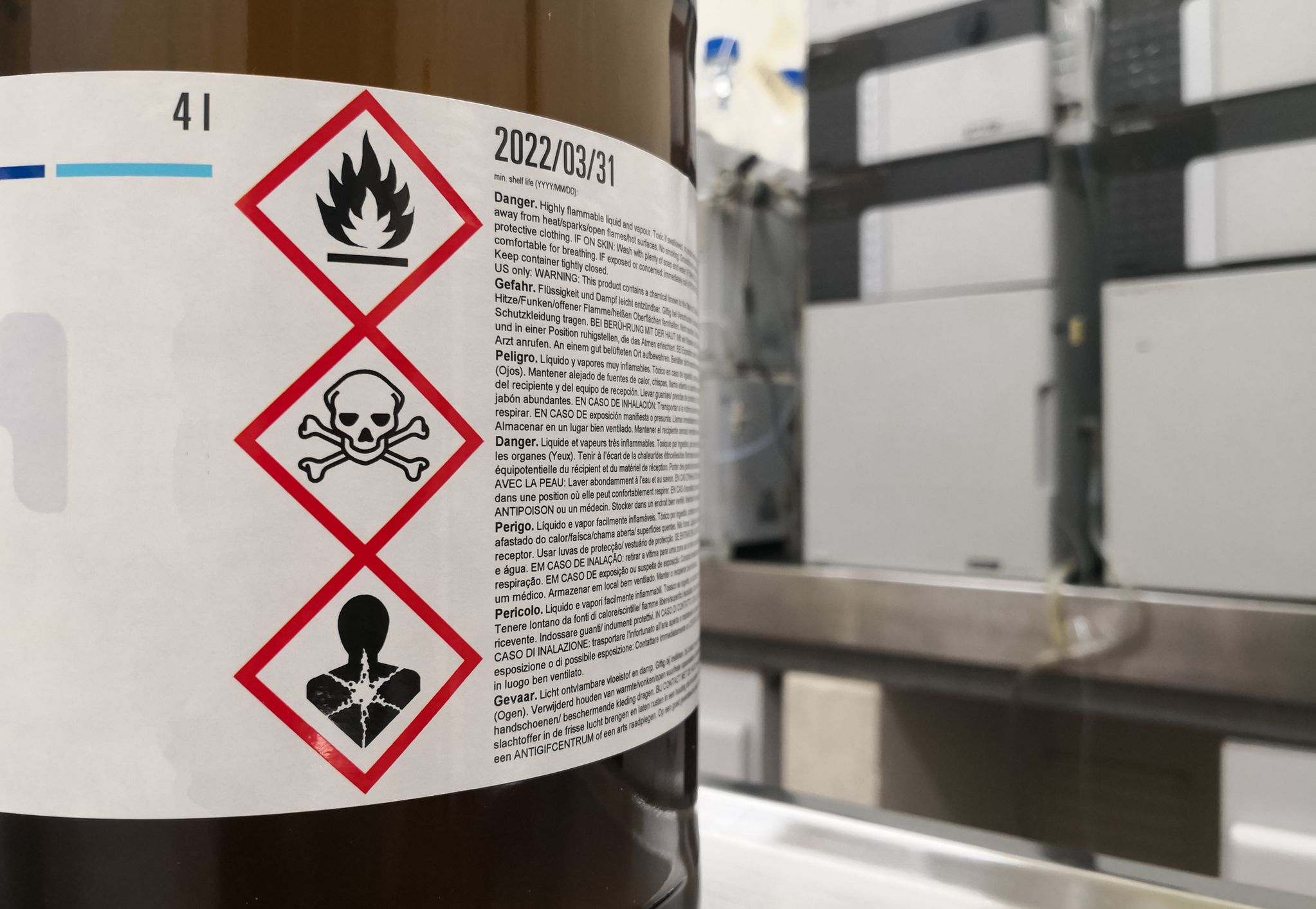
The manufacturer’s label on hazardous chemicals containers must include:
Product identifier
A signal word (e.g., danger, warning)
Hazard statement(s)
Pictogram(s)
Precautionary statement(s)
Manufacturer or importer’s name, U.S. address, and U.S. telephone number
While product labels are provided by the manufacturer or distributor, if chemicals are removed from the original, labeled container, organizations must create a workplace label for the secondary container. The workplace label must contain the product identifier and words, pictures, symbols, or combination thereof, which provide at least general information regarding the hazards of the chemicals.
There are a few exceptions to this requirement. For example, an employer is not required to label portable containers into which hazardous chemicals are transferred from labeled containers, and which are intended only for the immediate use of the employee who performs the transfer. Additionally, an employer may use signs, placards, process sheets, batch tickets, operating procedures, or other such written materials in lieu of affixing labels to individual stationary process containers, as long as the alternative method identifies the containers to which it is applicable and conveys the hazard information.
What are Safety Data Sheets?
Safety Data Sheets provide essential information on a hazardous chemical’s properties, risks, safe handling, storage, and necessary protective measures. Organizations must maintain an SDS for every hazardous chemical and ensure employees can access this information in their workspace.
Are There Training Requirements Associated with the Hazard Communication Standard?
OSHA requires that employers provide employees with information and training at their time of initial job assignment and again if new hazardous chemicals are introduced in the workplace, and they have not been previously trained on that material. This training ensures staff understand the associated risks and know how to work with hazardous chemicals safely.
WM’s Steri‑Safe OSHA Compliance Solutions offer online HazCom training that covers hazard types, SDS interpretation, and written program requirements.
What Should be Included in Employee Training and Information for the Hazard Communication Program?
Training and information should cover:
Details of the Hazard Communication Program
Operations in the work area where hazardous chemicals are present
The physical, health, and other hazards of chemicals in the work area
Safe work practices, use of PPE, and emergency procedures
How to access the written hazard communication program and chemical list
Explanation of labels and workplace labeling system used by the organization
The purpose of SDSs and how to access them
Methods to detect the release of chemicals
Ensure Your Organization’s Compliance with OSHA Training
As with other aspects of OSHA compliance, online training modules can provide a user-friendly, accessible format that staff can work on at their convenience. These tools document when training is complete, which is beneficial for demonstrating compliance.
WM’s Steri-Safe OSHA Compliance Solutions offer online training designed to help organizations meet OSHA requirements and maintain a safe workplace.
Learn more about how WM can help you comply with OSHA’s Hazard Communication Standard.
This article is for general information purposes only and should not be construed as legal advice on any specific facts or circumstances.
Managing Category A Waste in Healthcare: Key Preparedness Considerations