Exploring the Importance of Waste Acceptance Policies
A healthcare facility generates many different types of waste, some of which are biohazardous and need to be separated from other waste streams for treatment prior to end disposal. On average, hospitals in the U.S. produce 5 million tons of waste per year. The World Health Organization (WHO) states that out of the total amount of waste generated by healthcare activities, about 85% is general, non-hazardous waste, and the remaining 15% is considered hazardous material that may be infectious, toxic, or radioactive.
As a waste generator, a healthcare organization is responsible for adequately sorting the waste it produces and preparing it for disposal. There can be safety, compliance, and financial consequences if done incorrectly. In the U.S., medical waste is primarily regulated at the state and local levels, which can contribute to confusion among healthcare providers; therefore, it is crucial to understand the regulations that waste providers should follow to manage waste correctly.
The Relevance of Waste Acceptance Policies
Waste Acceptance Policies (WAPs) are a waste vendor’s requirements outlining what it will and will not accept, and under what conditions. These policies are often tied to considerations such as:
Regulations
Permit conditions
Business decisions
Safety
Operational capabilities
A Waste Acceptance Policy, which is often included with and incorporated into the service contract, may be stricter than applicable regulations. Healthcare facilities need to ensure that WAPs from all of their waste vendors are shared with those within the organization that are responsible for waste management. WM’s WAPs are available online for ease of reference.
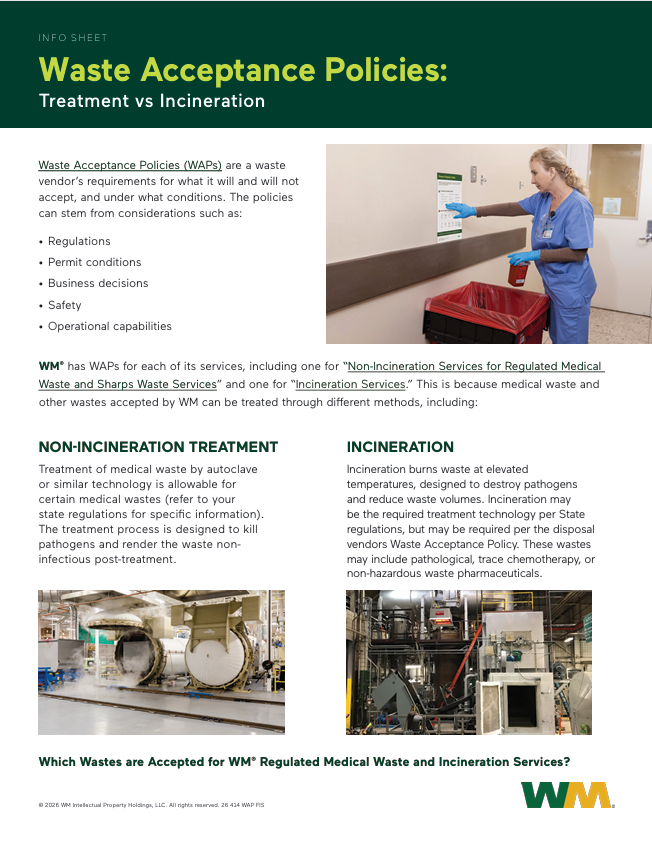
For its core medical waste services, WM has a WAP for “Non-Incineration Services for Regulated Medical Waste and Sharps” and one specific to “Incineration Services.” The applicable WAP will depend on the waste streams generated and the services purchased. For non-incineration services, most medical waste will be autoclaved.
Autoclaving: Autoclaving is the primary method for treating regulated waste. This process relies on steam at high temperature and pressure to kill pathogens and render materials non-infectious.
Incineration: Incineration burns regulated waste at elevated temperatures and reduces it to ash. Incineration is the recommended treatment option for some types of regulated waste such as pathological waste, trace chemotherapy waste, and pharmaceutical waste.
Understanding What Waste Streams Should be Autoclaved vs. Incinerated
Wastes Acceptable Under Both of WM’s Policies (Autoclave & Incineration Services)
RMW:
Biohazardous, biomedical, infectious, or regulated medical waste as defined under federal, state, or local law.
Waste known or reasonably expected to contain a pathogen.
A waste or reusable material derived from the medical treatment of an animal or human, which includes diagnosis and immunization, or from biomedical research, which includes the production and testing of biological products.
Sharps Waste (if containerized):
Any object currently contaminated with a pathogen or that may become contaminated with a pathogen through handling or during transportation and capable of cutting or penetrating the skin or packaging material.
Needles, syringes, scalpels, broken glass, culture slides, culture dishes, broken capillary tubes, broken rigid plastic, and exposed ends of dental wires.
Wastes Acceptable for Incineration Services ONLY
The items listed below are not accepted for autoclave treatment but can be incinerated if packaged appropriately per WM’s guidelines.
Pathological Waste (human or animal tissues, organs, limbs, surgical specimens, and other body parts)
Paraffin Wax Blocks (wax blocks with human or animal tissue embedded)
Animal Carcasses
Prion Waste
Pharmaceutical Waste (non-hazardous, non-controlled pharmaceutical waste that is not regulated as hazardous by the U.S Environmental Protection Agency (EPA), or equivalent state agency)
Trace Chemotherapy Waste (any waste contaminated through contact with, or having previously contained, chemotherapeutic agents)
Non-Conforming Waste: RMW and Incineration Services
Items that are never accepted by WM, regardless of autoclave or incineration treatment, include:
Complete human remains (including heads, full torsos, and fetuses)
Select agents or toxins, and untreated Category A infectious substances
Note that for certain untreated Category A infections substances, such as waste associated with the treatment of patients with Ebola virus, WM may be able to engage a subcontractor to provide services.
Controlled substances: Substances that are regulated by the U.S. Drug Enforcement Administration (DEA) or equivalent state agency (including medical cannabis)
Note that WM does offer services for ultimate users (patients) to dispose of controlled substances. Visit our Safe Community Solutions page to learn more.
Facilities Need a Waste Management Plan
The types and volumes of the waste streams you generate, and how they are regulated, may change over time. It is crucial to be as well-prepared as possible to address such situations. A Waste Management Plan outlines how a business will identify, segregate, store, and otherwise manage its wastes. The benefits of such a plan include:
Personnel safety
Regulatory compliance
Protection of the environment
Compliance with disposal vendor Waste Acceptance Policies
Compliance with 40 Code of Federal Regulations (CFR): § 60.55c Waste management plan if your healthcare facility uses incineration services
Learn more and download WM's Info Sheet for a detailed list of acceptable and non-conforming waste.
This article is for general information purposes only and should not be construed as legal advice on any specific facts or circumstances.
The Role of Waste Acceptance Policies in Healthcare Waste Management
Download Now